Project Duration
2026 – Present
Role
Senior Product Designer / First In-House Designer
Services Provided
Product Strategy | UX/UI Design | Venture Building | Operational UX | Design Systems | Mobile & Web Apps | Workflow Design | Prototyping | Product Discovery | Design Leadership | Stakeholder Collaboration | Design QA
Background
Core Connect is an autonomous delivery orchestration platform designed to connect the systems, vehicles and people required to operate autonomous last-mile delivery at scale.
The platform sits between delivery operators, autonomous vehicle providers, dark stores, operational teams and customers, coordinating everything from orders and missions to live fleet operations, incidents and human intervention.
I joined the venture as its first in-house Product Designer, taking ownership of the product experience across the platform while helping establish the foundations for how design works within the business.
Unlike a traditional consumer product, Core Connect is fundamentally an operational system. The challenge is not simply helping someone complete a task. It is giving operators enough visibility and control to understand what is happening across a distributed autonomous delivery network and make the right decision quickly when something goes wrong.
My Role
As the first dedicated designer in the team, my role extends across product design, systems thinking and design direction.
I work directly with product managers, engineers, architects, operations teams and leadership to turn complex operational and technical requirements into understandable workflows across web and mobile products.
My involvement spans the entire product lifecycle: defining problems, mapping operational workflows, exploring concepts, designing high-fidelity interfaces, prototyping interactions, working alongside engineering during implementation and reviewing the final experience through design QA.
Because the design function is still developing, I am also responsible for establishing design standards, improving our design system and introducing more consistent ways of approaching product design across the organisation.
Designing for Autonomous Operations
Autonomous delivery creates a very different design challenge from traditional software.
An order might involve a customer, dark store employee, autonomous vehicle, third-party vehicle provider, runner and remote operations agent, while moving through multiple physical and digital states.
The interface needs to make that complexity understandable without exposing the complexity of the underlying system.
Much of my work therefore focuses on designing around exceptions rather than only the ideal journey. What happens when a vehicle rejects a mission? When a cabinet fails to open? When a customer cannot collect an order? When connectivity is lost? Or when a human needs to take over an autonomous workflow?
Designing these scenarios requires understanding the entire operational system, not simply the screen being designed.
Areas I Work Across
Live operations and fleet monitoring
Autonomous vehicle and robot management
Order and mission orchestration
Incident detection and resolution
Human intervention workflows
Runner operations and task management
Warehouse and dark store operations
Maps, zones, stations and service areas
Policies and automated workflows
Roles and permissions
Operational reporting
Service and maintenance
Design systems and reusable patterns
Mobile and PWA experiences
Future drone and multi-modal delivery concepts
From Happy Paths to Exception Design
One of the biggest shifts in designing Core Connect has been recognising that the most important moments often happen when automation fails.
Instead of treating error states as secondary experiences, we design them as first-class operational workflows.
An incident needs to communicate what happened, how severe it is, how long it has been happening, what caused it, which assets are affected and, most importantly, what the operator should do next.
That thinking has influenced much of the platform and led to workflows designed around progressive resolution, clear operational status and actionable information rather than simply exposing system data.
Designing the Operational Ecosystem
Core Connect is not a single interface. It is a connected ecosystem of products used by people with very different responsibilities.
A remote operator needs visibility across hundreds of orders and assets. A dark store employee needs to load or unload a vehicle quickly. A runner needs to understand where to go and what intervention is required. An administrator needs to configure the rules that govern the system.
My work has focused on making these different experiences feel part of one coherent operational platform while optimising each interface for the context in which it is used.
Live Operations
A major area of my work has been rethinking Live Operations, the environment used by operators to monitor autonomous deliveries and respond when intervention is required.
The experience brings together orders, incidents, vehicles, runners and operational signals into a single workspace.
Instead of forcing operators to investigate multiple systems, the interface prioritises the information needed to understand:
What needs attention?
How urgent is it?
What caused it?
Who or what is affected?
What has already happened?
What should I do next?
This led to work across incident prioritisation, severity models, operational timelines, live maps, asset tracking and resolution workflows.
Designing Incident Resolution
Incidents are particularly challenging because an operator is often making decisions while an active delivery is already delayed.
I designed resolution workspaces that move beyond displaying an error and instead guide the operator through the appropriate response.
Depending on the incident, the system can support actions such as checking vehicle status, contacting a dark store, retrying a cabinet signal, remotely unlocking a vehicle, dispatching a runner, overriding an order or confirming delivery.
The interface progressively exposes the next appropriate action while maintaining a record of what has already happened.
This creates a more structured operational experience and reduces the amount of system knowledge an operator needs to keep in their head.
Designing for Human Intervention
Autonomous delivery does not eliminate people from the operation. It changes where people are needed.
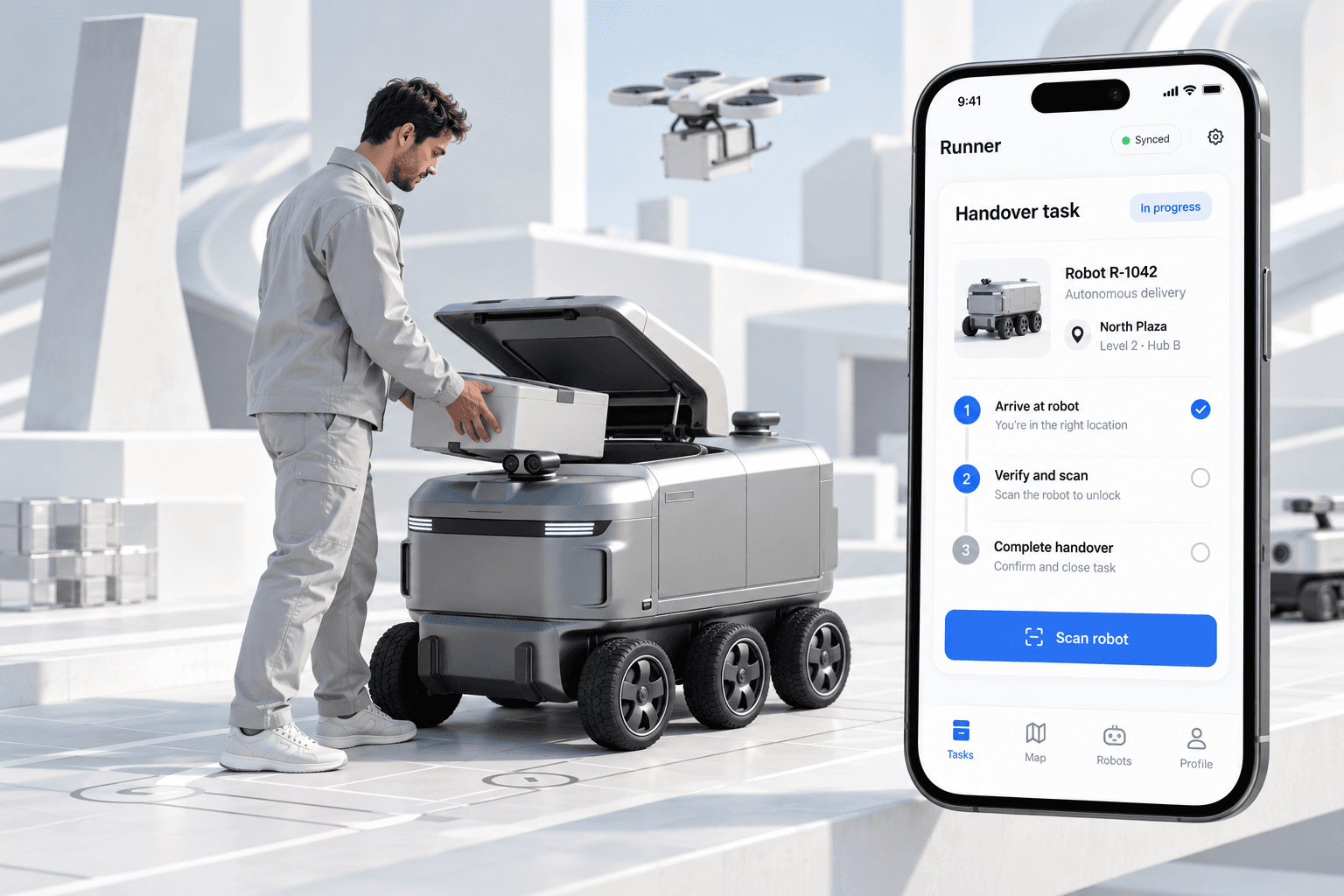
When a delivery cannot be completed autonomously, a runner can be dispatched to physically intervene.
I designed the Ground Operations experience as a lightweight mobile PWA supporting the complete intervention journey, including shift management, task allocation, navigation, QR scanning, vehicle interaction, proof of completion and handover back into the autonomous workflow.
The challenge was to make the experience extremely simple because runners may be using it outdoors, while moving between locations and under time pressure.
At the same time, every action needs to remain synchronised with the wider Core Connect platform so operators have visibility into what is happening in the field.
Live Maps and Asset Visibility
As autonomous operations scale, understanding where physical assets are becomes increasingly important.
I worked on map-based operational experiences bringing together autonomous vehicles, runners, orders, incidents, stations and service areas.
Rather than using the map purely for visualisation, I approached it as another operational interface. Operators should be able to understand asset state, identify areas requiring attention and move from geographic context directly into the relevant operational workflow.
This also required thinking about how location, asset state, severity and operational status can coexist without overwhelming the map.
Warehouse and Dark Store Operations
Autonomous delivery begins long before a vehicle reaches a customer.
I designed operational workflows used at warehouses and dark stores to request vehicles, prepare orders, load autonomous vehicles, verify cabinets and manage vehicles returning from delivery.
These interfaces need to bridge physical actions and digital system states, often while employees are working quickly in busy operational environments.
This reinforced the importance of designing around real-world context rather than treating the product as a purely digital experience.
Building a Scalable Design System
As the product expanded, maintaining consistency across a growing number of workflows became increasingly important.
I have been developing and evolving the Core Connect design system using ShadCN, Tailwind and reusable design tokens, creating a closer relationship between the components used in Figma and those implemented by engineering.
The system covers foundations such as colour, typography, spacing and interaction states alongside operational patterns including status indicators, data tables, filters, alerts, maps, timelines, resolution cards and complex forms.
The objective is not simply visual consistency. A shared system allows the team to design and build new operational capabilities faster while establishing predictable interaction patterns for users.
Designing With Engineering
A particularly important part of my role has been working closely with engineering rather than treating design handover as the end of the process.
I collaborate with engineers during refinement and implementation, use coded prototypes where useful, review edge cases and participate in design QA as features move into production.
Working with a component-based frontend architecture has also allowed design decisions to move closer to implementation, helping us think about patterns as reusable product infrastructure rather than isolated Figma screens.
Impact
My impact on Core Connect extends beyond individual features. As the first in-house Product Designer, I have helped establish how a highly technical autonomous-delivery system becomes a coherent product experience.
The work has involved creating new operational workflows, connecting previously separate parts of the delivery lifecycle and establishing foundations that can scale as the platform supports more vehicles, operators and delivery models.
Turning System Complexity Into Operational Clarity
I translated autonomous vehicle states, third-party integrations, delivery workflows and operational rules into interfaces that allow operators to understand what is happening and determine the next action without needing to interpret the underlying systems.
Building Human Intervention Into Autonomy
I helped define how human intervention becomes a structured part of the autonomous delivery lifecycle, connecting incident detection, operator decision-making, runner dispatch and physical intervention into a single operational workflow.
Connecting Digital and Physical Operations
My work spans software and real-world logistics, connecting orders, people, vehicles, cabinets, warehouses and physical locations through consistent digital workflows.
This required designing for what actually happens in the field, not just the ideal state represented by the system.
Creating a Scalable Product Language
Through the design system and reusable operational patterns, I have helped establish a common product language across Core Connect's web and mobile experiences.
This creates greater consistency while giving product and engineering a foundation for developing future capabilities more efficiently.
Expanding Beyond a Single Vehicle Type
The platform is being designed around orchestration rather than one specific robot or delivery method.
This means considering how the same underlying product can evolve to support autonomous vans, sidewalk robots, drones and future forms of autonomous delivery without redesigning the operational model for every new vehicle.
Venture Building Beyond the Interface
Working on Core Connect has increasingly moved my role beyond designing individual product features.
As an early design hire, I contribute to conversations around product direction, new operational models, future applications and how the wider product ecosystem should evolve.
That has meant thinking about everything from warehouse applications and runner operations to drone delivery and new autonomous-service models.
It has strengthened my interest in venture building and in using design not only to improve an existing product, but to help determine what the product should become.
What I Took Away
Core Connect has changed the way I think about designing intelligent and autonomous systems.
Automation does not necessarily make a product simpler. Behind a seemingly simple delivery is a network of vehicles, people, providers, rules, physical locations and software systems that constantly exchange information.
The role of product design is to decide how much of that complexity the user actually needs to see.
The strongest operational experiences are not the ones that expose the most information. They are the ones that surface the right information at the exact moment someone needs to make a decision.