Designing Beyond Traditional Banking
One of the most interesting parts of my work at ADIB was exploring how a bank can extend beyond traditional financial services.
I worked on digital ventures and partner-led experiences that introduced new services directly into the banking ecosystem. These projects required us to think beyond conventional banking journeys and consider how customers discover, understand, purchase and manage services provided through external partners.
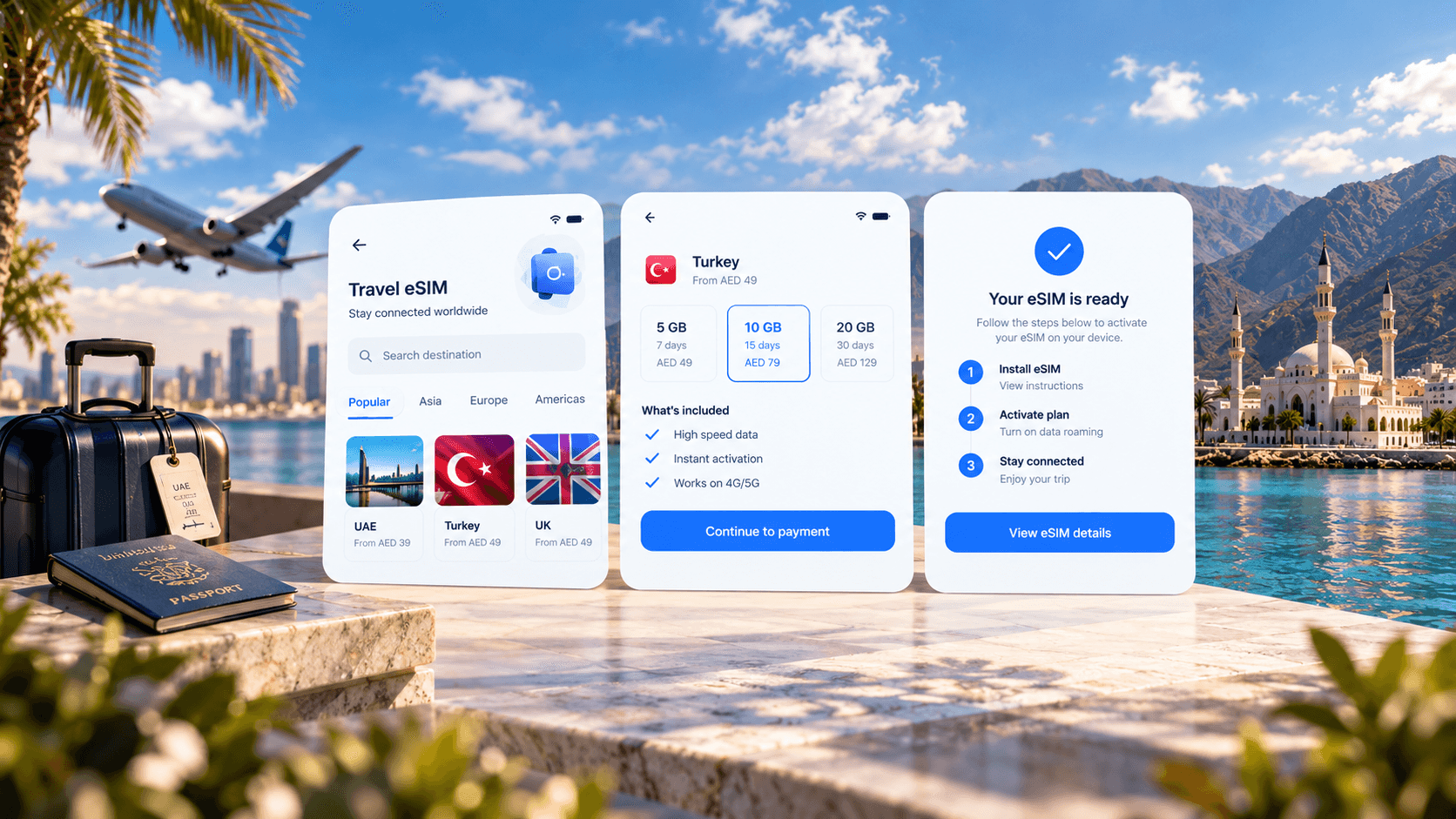
eSIM
The eSIM proposition explored how customers could discover and purchase international connectivity directly through their banking experience.
The journey covered the full lifecycle, from destination and plan discovery through to payment, activation, installation guidance and ongoing management.
The design challenge was not simply to create a purchase flow. It was to make an unfamiliar technical product feel understandable within a trusted banking environment.
Fintech Partnerships
I also worked on partner-led propositions and embedded financial experiences where ADIB connected customers with third-party products and services.
These journeys introduced an additional layer of complexity because the customer experience could move between ADIB and external systems while still needing to feel coherent and trustworthy.
My role was to help create clear interaction models, establish consistent experience patterns and ensure that customers understood where they were, what they were agreeing to and what would happen next.
Developer Experience and API Banking
My work also extended beyond consumer-facing products into developer experience.
I contributed to experiences around API discovery, technical onboarding and developer platforms, where the user is no longer a retail banking customer but a developer or business integrating with ADIB.
The design principles remain surprisingly similar: reduce complexity, establish clear information hierarchy, provide useful feedback and make the next action obvious.
Designing for both customers and developers strengthened the way I think about product design. The interface may change, but the fundamental challenge remains the same: helping users understand complex systems.
Impact
My work at ADIB contributed across multiple products, platforms and teams rather than a single isolated feature.
The impact was primarily in improving clarity, consistency and scalability across complex digital banking experiences.
Simplifying Complex Journeys
I translated technical and regulatory requirements into clearer customer-facing journeys, helping reduce the amount of complexity users needed to understand in areas such as regulatory declarations, partner integrations and emerging digital services.
Expanding the Digital Banking Experience
I contributed to propositions that extended the traditional banking experience into areas such as embedded services, fintech partnerships, eSIM and API banking.
This required creating interaction patterns that could support new products while still feeling consistent with the wider ADIB experience.
Improving Cross-Platform Consistency
I contributed to reusable design patterns and system-level thinking across mobile and web experiences, helping reduce unnecessary variation between products and journeys.
Designing for Multiple User Types
My work covered customer-facing banking, partner experiences and developer platforms.
This gave me the opportunity to design for very different user needs while applying the same core principles of clarity, hierarchy and usability.
Supporting Delivery
Beyond producing design outputs, I worked closely with product and engineering teams through refinement, implementation and design QA to help ensure the final experience remained aligned with the original design intent.
Creating Scalable Solutions
Projects such as the UAE Dirham symbol rollout and design system improvements required thinking beyond individual screens and considering how changes could scale across the wider banking ecosystem.
What I Took Away
Working at ADIB changed the way I approach complex product design.
It taught me to look beyond individual screens and consider the wider system around them: regulation, technology, operations, partners, design systems and the teams responsible for delivering the experience.
It also reinforced something I strongly believe about product design: the more complex the system is behind the interface, the simpler the experience should feel to the person using it.